

Motion sensors are the silent guardians of modern security systems. Whether it’s a home alarm, smart lighting, or commercial surveillance, these small devices play a big role. But have you ever wondered how they actually work?
Not all motion sensors are created equal. Some detect body heat, others use radio waves, and some combine both for maximum accuracy. Understanding the differences can help you choose the right sensor - and avoid false alarms that drive you crazy.
Let’s break it down in a simple, practical way.
What Is a Motion Sensor?
A motion sensor is a device that detects movement in a specific area and triggers an action - like turning on a light, sounding an alarm, or sending a notification.
Common Uses
- Home security systems
- Automatic lighting
- Smart home automation
- Office and warehouse monitoring
Think of it like an invisible guard that never blinks.
How Motion Sensors Detect Movement
Different sensors use different technologies, but the goal is the same: detect changes in the environment.
Basic Detection Principles
- Detect heat changes
- Detect movement of objects
- Detect disruption in waves (infrared or radio)
When a change is detected, the sensor sends a signal to a control system.
Types of Motion Sensors
There are three major types you should know:
- PIR (Passive Infrared) Sensors
- Microwave Sensors
- Dual-Technology Sensors
Each has its own strengths, weaknesses, and ideal use cases.
PIR Motion Sensors (Passive Infrared)
How PIR Sensors Work
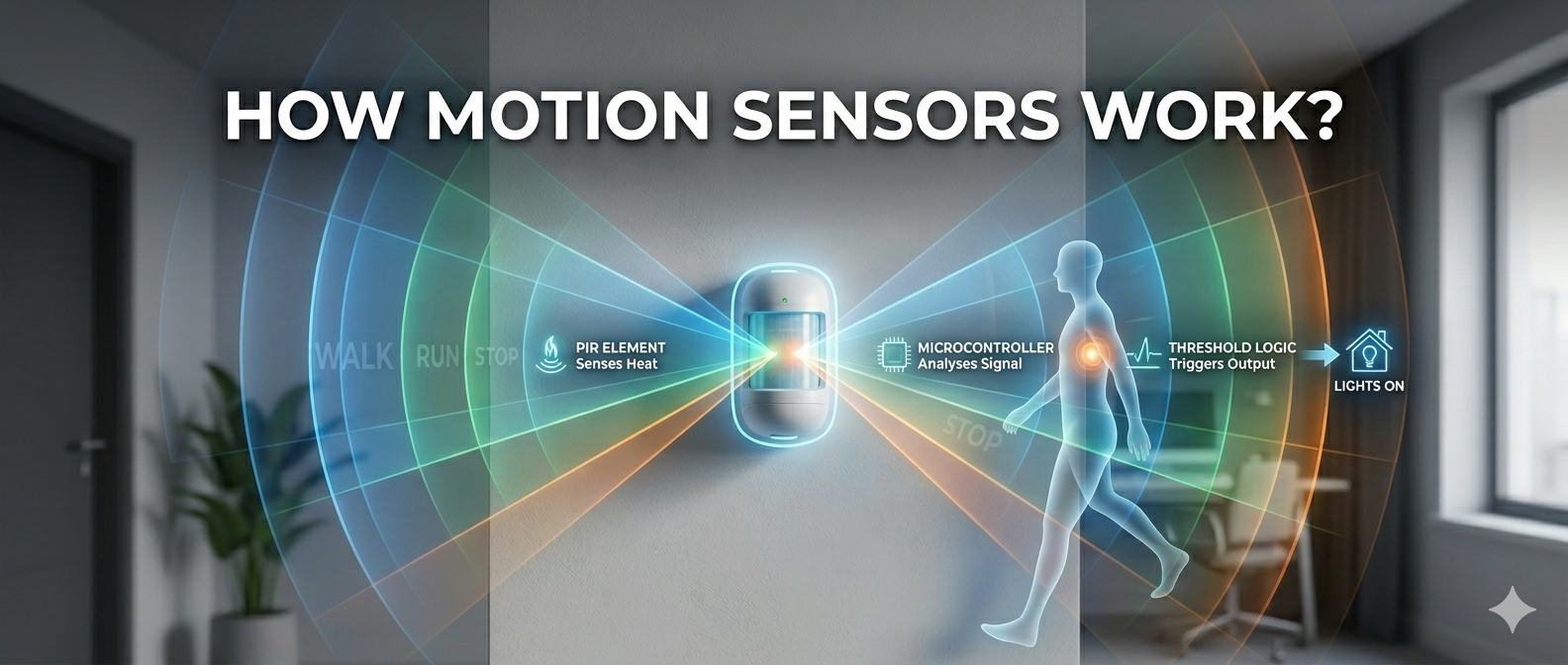
PIR sensors detect infrared radiation (heat) emitted by objects - especially humans and animals.
Key Working Principle
- Every object emits heat energy
- PIR sensors detect changes in heat levels
- Movement across the sensor’s field triggers detection
They don’t emit anything - they simply “listen” for heat changes.
Features of PIR Sensors
- Passive detection (no energy emitted)
- Wide coverage area
- Energy-efficient operation
- Affordable and widely used
Advantages of PIR Sensors
- Low power consumption → Ideal for battery-powered devices
- Cost-effective → Budget-friendly option
- Reliable for human detection → Great for indoor use
Minimal interference → Less affected by electronic noise
Limitations of PIR Sensors
- Sensitive to temperature changes → Can be affected by sunlight or heaters
- Limited range compared to microwave sensors
- Requires line-of-sight → Cannot detect through walls
- May miss slow movements
Best Use Cases for PIR Sensors
- Indoor home security systems
- Motion-activated lighting
- Hallways and entry points
- Small to medium rooms
Microwave Motion Sensors
How Microwave Sensors Work
Microwave sensors emit microwave signals and measure how they bounce back.
Key Working Principle
- Sensor sends out continuous microwave pulses
- Waves reflect off objects
- Changes in reflected signals indicate movement
This is similar to radar technology.
Features of Microwave Sensors
- Active detection (emits energy)
- Highly sensitive
- Can detect movement through objects like walls or glass
Advantages of Microwave Sensors
- High sensitivity → Detects even small movements
- Longer range → Covers larger areas
- Can penetrate obstacles → Works through thin walls and glass
- Better for outdoor use
Limitations of Microwave Sensors
- Higher cost compared to PIR
- More prone to false alarms → Detects movement beyond intended area
- Consumes more power
- Potential interference from other devices
Best Use Cases for Microwave Sensors
- Large outdoor areas
- Warehouses and garages
- Commercial security systems
- Perimeter detection
Dual-Technology Motion Sensors
How Dual Sensors Work
Dual-technology sensors combine PIR and microwave technologies.
Key Working Principle
- Both PIR and microwave sensors must detect motion
- Alarm triggers only when both agree
This reduces false alarms significantly.
Features of Dual Sensors
- Combines passive and active detection
- Higher accuracy
- Advanced filtering of false triggers
Advantages of Dual Sensors
- Reduced false alarms → Requires dual confirmation
- Highly reliable → Works in complex environments
- Balanced sensitivity and accuracy
- Ideal for critical security areas
Limitations of Dual Sensors
- More expensive
- Slightly more complex installation
- Higher power usage than PIR alone
Best Use Cases for Dual Sensors
- High-security zones
- Outdoor environments with movement noise
- Areas with pets or environmental changes
- Commercial buildings
Key Differences: PIR vs Microwave vs Dual Sensors
Detection Method
- PIR → Detects heat
- Microwave → Uses radio waves
- Dual → Combines both
Sensitivity
- PIR → Moderate
- Microwave → High
- Dual → Balanced and accurate
False Alarm Rate
- PIR → Low
- Microwave → Higher
- Dual → Very low
Cost
- PIR → Low
- Microwave → Medium to high
- Dual → Highest
Choosing the Right Motion Sensor
Selecting the right sensor depends on your environment and needs.
Ask Yourself:
- Is the area indoors or outdoors?
- Do you have pets?
- How large is the coverage area?
- Do you want fewer false alarms or maximum sensitivity?
Quick Recommendations
- Small indoor spaces → PIR sensors
- Large or outdoor areas → Microwave sensors
High-security or complex environments → Dual-technology sensors
Tips to Improve Motion Sensor Performance
Even the best sensor needs proper setup.
Installation Tips
- Avoid pointing sensors at windows or heat sources
- Install at recommended height
- Keep away from moving objects like fans or curtains
- Regularly clean and maintain sensors
Common Mistakes to Avoid
- Installing sensors too high or too low
- Ignoring manufacturer guidelines
- Using the wrong sensor type for the environment
- Overlooking pets and environmental factors
The Future of Motion Sensors
Motion sensors are getting smarter with AI and machine learning.
Future improvements may include:
- Better human vs object detection
- Reduced false alarms
- Integration with smart home ecosystems
- Energy-efficient designs
The goal? Smarter security with less hassle.
Conclusion
Motion sensors are the backbone of modern security systems, but choosing the right type makes all the difference. PIR sensors are affordable and reliable for indoor use, microwave sensors offer extended range and sensitivity, and dual-technology sensors provide the best of both worlds with enhanced accuracy.
Understanding how these sensors work helps you make smarter decisions, reduce false alarms, and build a security system that truly protects your space. In the end, it’s not just about detecting motion - it’s about detecting it the right way.
FAQs
Q. Which motion sensor is best for home security?
PIR sensors are great for most homes, but dual-technology sensors are for higher accuracy and fewer false alarms.
Q. Is it safe to post vacation photos in real time?
Yes, they can detect movement through thin walls and glass, which can sometimes lead to false alarms.
Q. Are dual-technology sensors worth the cost?
Yes, especially in environments where false alarms are a concern or higher security is required.
Q. Can pets trigger motion sensors?
Yes, but many modern sensors have pet-immune features to reduce false alarms.
Q. Where should I place motion sensors?
Place them in corners, entry points, and high-traffic areas, avoiding direct sunlight and heat sources.